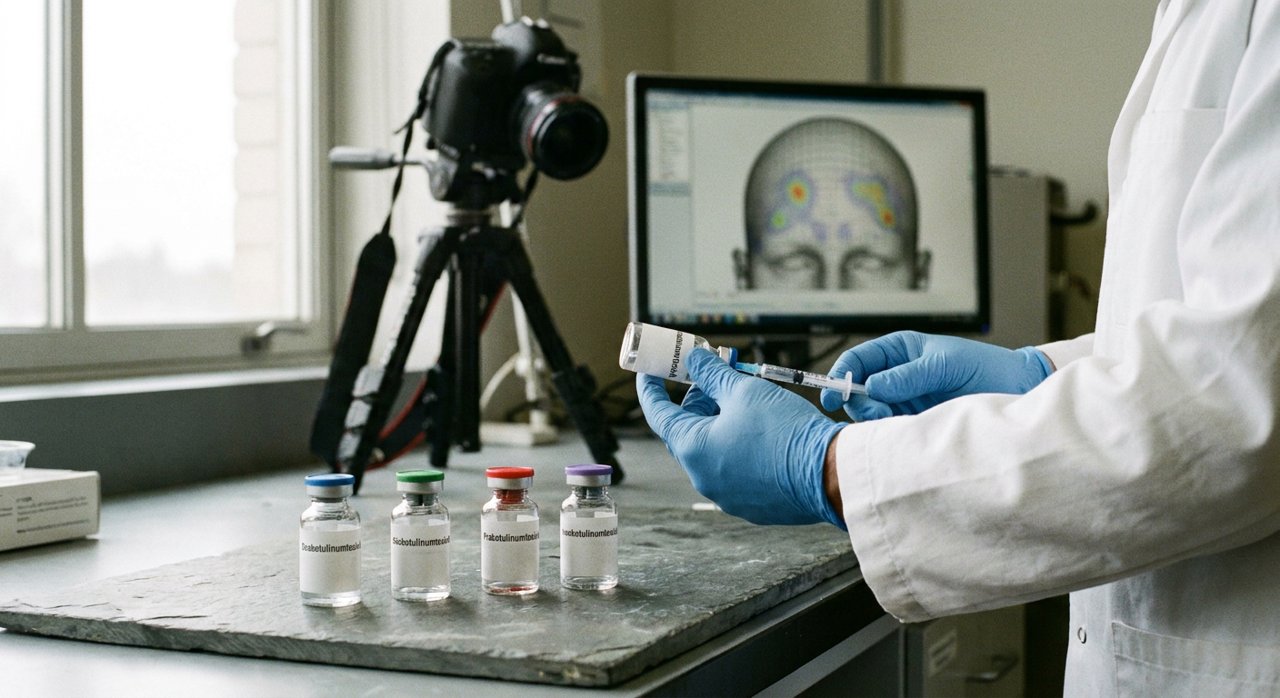
Published in JAMA Dermatology on May 28, 2025, this single-center, double-blind RCT randomized 143 women (139 analyzed), ages 30 to 65, 1:1:1:1 to label-equivalent doses of four neurotoxins: onabotulinumtoxinA 20U (Botox), abobotulinumtoxinA 50U (Dysport), prabotulinumtoxinA 20U (Jeuveau), and incobotulinumtoxinA 20U (Xeomin). The useful part is the outcome itself: dynamic glabellar strain measured objectively by 3D photogrammetry at days 3, 30, 90, and 180, rather than a grader eyeballing photos.
Onset separated the products. At day 3, abo cut strain 67.4% and pra 61.7%, both significantly faster than ona at 48.0% (p=.001) and inco at 40.3% (p=.002). By day 30 that gap closed completely: all four converged to roughly 88 to 93% strain reduction with no significant difference between them, cohort median 88%. The back end separated them again. At day 180, pra retained the most residual effect (about 20.5%) versus near-baseline ona (about 0.5%, p=.03), and abo showed no significant sustained effect at 6 months. Doses were standard label-equivalents, so this reflects the molecule, not under- or over-dosing.
The practical read: match the toxin to the goal. Patient with an event in 3 to 4 days, reach for Dysport or Jeuveau for fastest onset. Want the longest 6-month tail, Jeuveau led. Because all four hit essentially the same peak at one month, peak result is not a differentiator. Counsel on onset and longevity, not on which one "works better."
Source: JAMA Dermatology — https://jamanetwork.com/journals/jamadermatology/fullarticle/2834687